





- Recherche - CLM,
Blended Intensive Program (BIP) « Hortus Spinozanum III: Thinking Emancipation »
Publié le 9 février 2026
–
Mis à jour le 26 mai 2026
Date(s)
du 25 mai 2026 au 5 juin 2026
online sessions: May 25 to May 29, 2026
physical mobility phase: Paris from June 1 to June 5, 2026
physical mobility phase: Paris from June 1 to June 5, 2026
Lieu(x)
From Monday 1st of june to June 5th:
Salle des Conseils
Bâtiment Paul Ricoeur
How to get to Université Paris Nanterre:
https://university.parisnanterre.fr/how-to-get-to-our-university
Link to campus map:
https://www.parisnanterre.fr/plan-du-campus
Salle des Conseils
Bâtiment Paul Ricoeur
How to get to Université Paris Nanterre:
https://university.parisnanterre.fr/how-to-get-to-our-university
Link to campus map:
https://www.parisnanterre.fr/plan-du-campus
BIP - Hortus Spinozanum III: Thinking Emancipation
Organizers: Luigi Emilio Pischedda and Pascal Sévérac
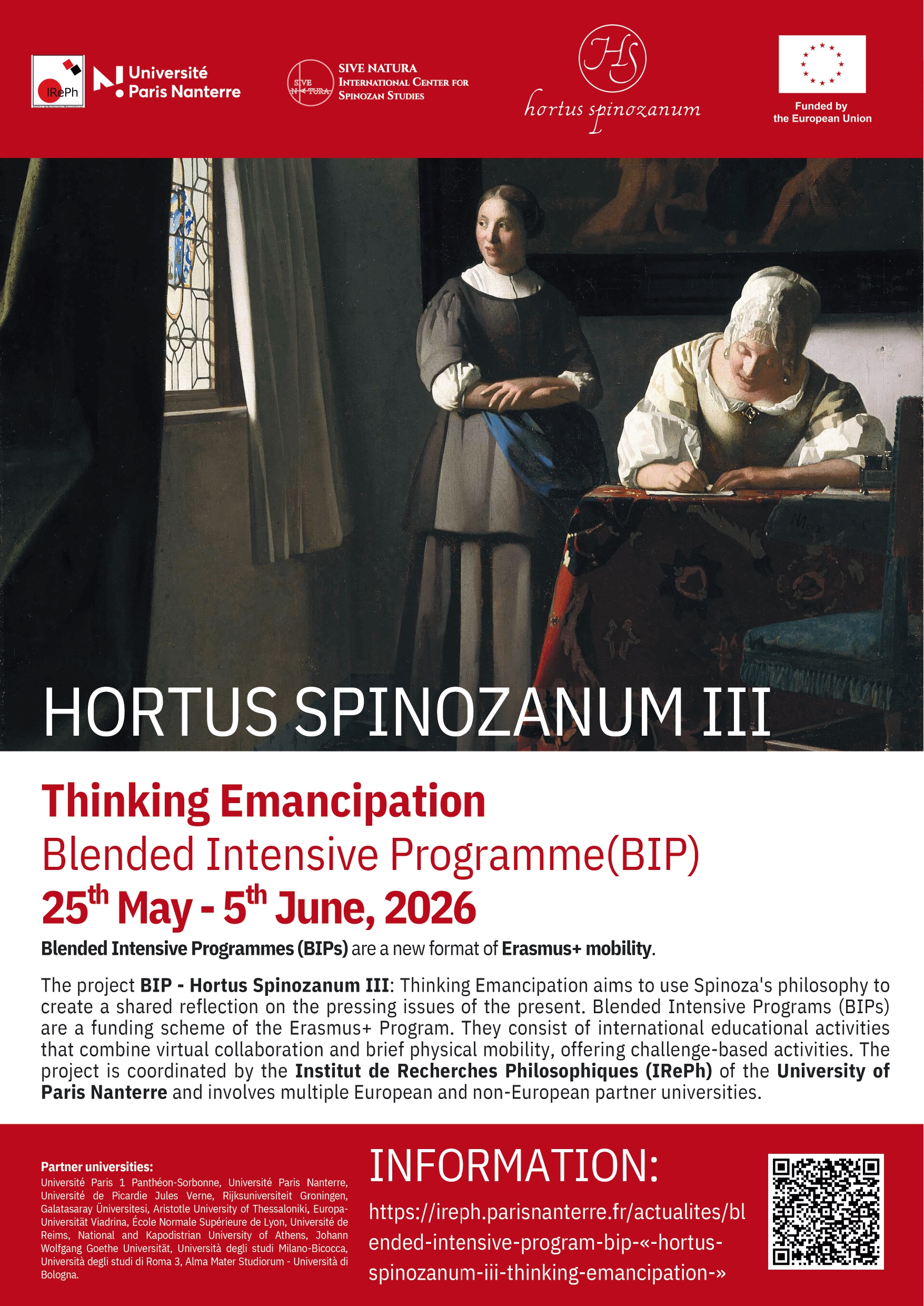
The project BIP - Hortus Spinozanum III: Thinking Emancipation aims to use Spinoza's philosophy to create a shared reflection on the pressing issues of the present. Blended Intensive Programs (BIPs) are a funding scheme of the Erasmus+ Program. They consist of international educational activities that combine virtual collaboration and brief physical mobility, offering challenge-based activities. The project is coordinated by the Institut de Recherches Philosophiques (IRePh) of the University of Paris Nanterre and involves multiple European and non-European partner universities.
The project explores the potential of blended learning by combining in-person and online activities involving teachers, students, and lecturers to foster the development of a broad, multidisciplinary collaboration network. The activities are structured in two phases: the online sessions will be held from May 25 to May 29, 2026, while the physical mobility phase will take place in Paris from June 1 to June 5, 2026. The phase in Paris will consist of workshops, collective readings, presentations, and discussions involving students from all three cycles of study (Bachelor, Master, and PhD) and lecturers from the partner institutions. It utilizes a bottom-up approach aimed at fostering collective dialogue. The programme carries 6 ECTS credits, and a certificate of attendance will be delivered at the end of the activities.
Activities will be conducted mainly in English and French.
In addition to providing critical tools for interpreting the present era from a Spinozian perspective, the project also offers an opportunity to study multiple aspects of Spinozism and Spinoza's thought. The project foregrounds critical-analytical reading of his texts, the study of its theoretical roots, and the historical-philosophical context in which Spinoza lived and worked, as well as an exploration of how his thought has been inherited, commented on, and criticised or extended by later thinkers. The objectives pursued include the acquisition of a vocabulary appropriate to the students' orientation towards the historical and philosophical issues in question, as well as knowledge of the secondary literature essential for contextualising these issues within the historiographical debate.
Partner universities: Université Paris 1 Panthéon-Sorbonne, Université Paris Nanterre, Université de Picardie Jules Verne, Rijksuniversiteit Groningen, Galatasaray Üniversitesi, Aristotle University of Thessaloniki, Europa-Universität Viadrina, École Normale Supérieure de Lyon, Université de Reims, National and Kapodistrian University of Athens, Johann Wolfgang Goethe Universität, Università degli studi Milano-Bicocca, Università degli studi di Roma 3, Alma Mater Studiorum - Università di Bologna.
Programme :
Organizers: Luigi Emilio Pischedda and Pascal Sévérac
The project BIP - Hortus Spinozanum III: Thinking Emancipation aims to use Spinoza's philosophy to create a shared reflection on the pressing issues of the present. Blended Intensive Programs (BIPs) are a funding scheme of the Erasmus+ Program. They consist of international educational activities that combine virtual collaboration and brief physical mobility, offering challenge-based activities. The project is coordinated by the Institut de Recherches Philosophiques (IRePh) of the University of Paris Nanterre and involves multiple European and non-European partner universities.
The project explores the potential of blended learning by combining in-person and online activities involving teachers, students, and lecturers to foster the development of a broad, multidisciplinary collaboration network. The activities are structured in two phases: the online sessions will be held from May 25 to May 29, 2026, while the physical mobility phase will take place in Paris from June 1 to June 5, 2026. The phase in Paris will consist of workshops, collective readings, presentations, and discussions involving students from all three cycles of study (Bachelor, Master, and PhD) and lecturers from the partner institutions. It utilizes a bottom-up approach aimed at fostering collective dialogue. The programme carries 6 ECTS credits, and a certificate of attendance will be delivered at the end of the activities.
Activities will be conducted mainly in English and French.
In addition to providing critical tools for interpreting the present era from a Spinozian perspective, the project also offers an opportunity to study multiple aspects of Spinozism and Spinoza's thought. The project foregrounds critical-analytical reading of his texts, the study of its theoretical roots, and the historical-philosophical context in which Spinoza lived and worked, as well as an exploration of how his thought has been inherited, commented on, and criticised or extended by later thinkers. The objectives pursued include the acquisition of a vocabulary appropriate to the students' orientation towards the historical and philosophical issues in question, as well as knowledge of the secondary literature essential for contextualising these issues within the historiographical debate.
Partner universities: Université Paris 1 Panthéon-Sorbonne, Université Paris Nanterre, Université de Picardie Jules Verne, Rijksuniversiteit Groningen, Galatasaray Üniversitesi, Aristotle University of Thessaloniki, Europa-Universität Viadrina, École Normale Supérieure de Lyon, Université de Reims, National and Kapodistrian University of Athens, Johann Wolfgang Goethe Universität, Università degli studi Milano-Bicocca, Università degli studi di Roma 3, Alma Mater Studiorum - Università di Bologna.
Programme :
1- Online sessions: May 26 and May 27, 2026
Tuesday 26th May
9h-11h: Martin Saar, Ivo Eichhorn & Andrea C. Blättler: “Spinoza, Life, Power”
Wednesday 27th May
9h-10h: Zehao Yin: “Spinoza on the Union of Mind and Body”
10h-11h: Fabio Carnevali: “A Spinozist Reading of Eco-Anarchism”
11h-12h : Henrique Souza Bittencourt : « À quoi sert-il de lire Spinoza comme un système clos ? »
9h-11h: Martin Saar, Ivo Eichhorn & Andrea C. Blättler: “Spinoza, Life, Power”
Wednesday 27th May
9h-10h: Zehao Yin: “Spinoza on the Union of Mind and Body”
10h-11h: Fabio Carnevali: “A Spinozist Reading of Eco-Anarchism”
11h-12h : Henrique Souza Bittencourt : « À quoi sert-il de lire Spinoza comme un système clos ? »
***
2- Journée des doctorants
Vendredi 29 mai à l’Université de Picardie Jules Verne
Actualités du Traité politique de Spinoza
Les interventions seront toutes en français, un résumé substantiel en anglais sera proposé.
Journée en hybride :
https://u-picardie-fr.zoom.us/j/93863822104?pwd=ryL8xlcyQLnuLtRHLEdiemhgFMXPYo.1
Vendredi 29 mai à l’Université de Picardie Jules Verne
Actualités du Traité politique de Spinoza
Les interventions seront toutes en français, un résumé substantiel en anglais sera proposé.
Journée en hybride :
https://u-picardie-fr.zoom.us/j/93863822104?pwd=ryL8xlcyQLnuLtRHLEdiemhgFMXPYo.1
***
3- Université Paris Nanterre
Du lundi 1er au vendredi 5 juin 2026
Bâtiment Paul Ricoeur – Salle des Conseils (4ème étage)
Une version en anglais des conférences en français sera proposée.
3- Université Paris Nanterre
Du lundi 1er au vendredi 5 juin 2026
Bâtiment Paul Ricoeur – Salle des Conseils (4ème étage)
Une version en anglais des conférences en français sera proposée.
Lundi 1er juin
9h30-11h : Pierre-François Moreau : « Potentia, potestas… ius »
11h-12h30 : Katja Diefenbach: “Deleuze's Spinoza and the Enigma of the Doctrine of Attributes”
14h30-16h : Ariel Suhamy : « Comment ne pas lire Spinoza ».
Mardi 2 juin
9h30-11h : Gaye Çankaya Eksen: “Relational Richness of the Body, Cognitive Emancipation of the Mind”
11h-12h30 : Diego Donna : « Les raisons de la force. Boulainvilliers lecteur de Spinoza, entre conatus et droit »
14h30-16h : Sebastian Dute: “The problem of resistance in Spinoza's political philosophy”
Mercredi 3 juin
9h30-11h : Francesco Toto : « Le Chapitre I du TTP : La prophétie »
11h-12h30 : Andrea Sangiacomo: “Spinoza's recasting of divine proximity”
14h30-16h : Ioannis Prelorentzos : « Spinoza et Bergson : convergences et divergences ».
Jeudi 4 juin
9h30-11h : Gabriel Frizzarin & Iago Orlandi Gazola: Brazilian PhD Panel
11h-12h30 : Dani Barki Minkovicius & Matheus Romero de Morais: PhD Panel
14h30-16h : Filippo Del Lucchese: “Subject and Relation: Pathways between Spinoza and Marx”
Vendredi 5 juin
9h30-11h : Lorenzo Vinciguerra: “Spinoza Beyond Good and Evil?”
11h-12h30 : Chantal Jaquet : « La cause de la servitude ou le problème du possible et du contingent »
14h30-16h : Laurent Bove : « Une pensée inédite des contre-pouvoirs et de la décision démocratique »
Comité d’organisation pour l’université Paris Nanterre
Luigi Emilio Pischedda – Zehao Yin (IRePh) – Fabio Carnevali (IRePh) – Pascal Sévérac (IRePh)
Partner universities:
Rijksuniversiteit Groningen – Galatasaray Üniversitesi – Aristotle University of Thessaloniki – Europa-Universität Viadrina – National and Kapodistrian University of Athens – Johann Wolfgang Goethe Universität – Università degli studi Milano-Bicocca – Università degli studi di Roma 3 – Alma Mater Studiorum – Università di Bologna – École Normale Supérieure de Lyon – Université de Reims – Université Paris 1 Panthéon-Sorbonne –Université de Picardie Jules Verne – Université Paris Nanterre
9h30-11h : Pierre-François Moreau : « Potentia, potestas… ius »
11h-12h30 : Katja Diefenbach: “Deleuze's Spinoza and the Enigma of the Doctrine of Attributes”
14h30-16h : Ariel Suhamy : « Comment ne pas lire Spinoza ».
Mardi 2 juin
9h30-11h : Gaye Çankaya Eksen: “Relational Richness of the Body, Cognitive Emancipation of the Mind”
11h-12h30 : Diego Donna : « Les raisons de la force. Boulainvilliers lecteur de Spinoza, entre conatus et droit »
14h30-16h : Sebastian Dute: “The problem of resistance in Spinoza's political philosophy”
Mercredi 3 juin
9h30-11h : Francesco Toto : « Le Chapitre I du TTP : La prophétie »
11h-12h30 : Andrea Sangiacomo: “Spinoza's recasting of divine proximity”
14h30-16h : Ioannis Prelorentzos : « Spinoza et Bergson : convergences et divergences ».
Jeudi 4 juin
9h30-11h : Gabriel Frizzarin & Iago Orlandi Gazola: Brazilian PhD Panel
11h-12h30 : Dani Barki Minkovicius & Matheus Romero de Morais: PhD Panel
14h30-16h : Filippo Del Lucchese: “Subject and Relation: Pathways between Spinoza and Marx”
Vendredi 5 juin
9h30-11h : Lorenzo Vinciguerra: “Spinoza Beyond Good and Evil?”
11h-12h30 : Chantal Jaquet : « La cause de la servitude ou le problème du possible et du contingent »
14h30-16h : Laurent Bove : « Une pensée inédite des contre-pouvoirs et de la décision démocratique »
Comité d’organisation pour l’université Paris Nanterre
Luigi Emilio Pischedda – Zehao Yin (IRePh) – Fabio Carnevali (IRePh) – Pascal Sévérac (IRePh)
Partner universities:
Rijksuniversiteit Groningen – Galatasaray Üniversitesi – Aristotle University of Thessaloniki – Europa-Universität Viadrina – National and Kapodistrian University of Athens – Johann Wolfgang Goethe Universität – Università degli studi Milano-Bicocca – Università degli studi di Roma 3 – Alma Mater Studiorum – Università di Bologna – École Normale Supérieure de Lyon – Université de Reims – Université Paris 1 Panthéon-Sorbonne –Université de Picardie Jules Verne – Université Paris Nanterre
Informations ici
Mis à jour le 26 mai 2026